

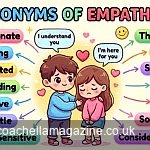
Understanding Empathy and the Need for Synonyms
Empathy is the ability to feel and understand another person’s emotions, a skill prized in both personal and professional realms. Writers often search for an empathetic synonym to convey this nuance without repetition, enriching their prose and resonating with readers. Knowing why varied language matters is the first step toward more vivid storytelling.
In today’s content‑driven world, search engines reward fresh vocabulary, and readers appreciate precise expression. An empathetic synonym can shift tone from formal to conversational, or from subtle to powerful, depending on context. Mastering these alternatives elevates clarity and emotional impact.
Beyond mere word swapping, selecting the right synonym reflects cultural sensitivity and emotional intelligence. It signals that the writer respects the depth of human feeling, a crucial factor for audience trust and engagement. This guide walks you through the most reliable options available.
Core Synonyms from Leading Thesauruses
Major reference sites list a handful of primary alternatives for “empathetic.” Merriam‑Webster highlights terms like “compassionate,” “understanding,” and “sympathetic,” each carrying a slightly different shade of meaning. Thesaurus.com expands the list to fifteen options, including “caring” and “sensitive.”
PowerThesaurus pushes the count even higher, offering up to 750 related words and phrases. While many are rare, the breadth demonstrates how language evolves to capture subtle emotional states. Selecting from this pool requires attention to nuance and audience expectations.
Below is a concise collection of the most widely accepted empathetic synonyms that work across academic, business, and creative writing:
- Compassionate
- Understanding
- Sympathetic
- Kind‑hearted
- Considerate
- Warm‑hearted
- Responsive
- Humanitarian
Each term can stand alone or combine with modifiers for richer description, such as “deeply compassionate” or “genuinely understanding.” Knowing these core options provides a solid foundation for any writing project.
Nuanced Variations: When Subtlety Matters
Not all synonyms convey the same intensity. “Compassionate” suggests a proactive desire to alleviate suffering, while “sympathetic” often implies a more passive, feeling‑with stance. Understanding these subtleties helps writers avoid miscommunication.
“Kind‑hearted” leans toward moral goodness, whereas “considerate” emphasizes attentiveness to another’s needs. “Warm‑hearted” adds an element of emotional warmth, making it ideal for narrative scenes that require tenderness.
For professional contexts, “responsive” or “attuned” may better describe a team’s ability to address client concerns. These choices keep the tone appropriate while still delivering an empathetic synonym that resonates with stakeholders.
Contextual Usage: Formal vs. Informal Settings
In academic papers, precision is paramount; “empathetic” often appears alongside “cognitive empathy” or “affective empathy.” Here, “sympathetic” may be too colloquial, while “compassionate” aligns with scholarly discourse on altruism.
Conversational blog posts benefit from approachable language. Using “caring” or “kind‑hearted” feels natural to readers and maintains a friendly voice. The key is to match the synonym’s register with the overall tone of the piece.
Marketing copy frequently blends emotional appeal with persuasive intent. Phrases like “a compassionate brand” or “understanding customer service” signal that the company values its audience, leveraging an empathetic synonym to build loyalty.
Expanding Your Vocabulary: Lesser‑Known Empathetic Synonyms
Beyond the common list, there are hidden gems that can set your writing apart. Words such as “solicitous,” “benign,” and “pietistic” offer a scholarly flair, while “tender‑hearted” and “soft‑spoken” add poetic texture.
Regional variations also enrich expression. In British English, “humanitarian” often carries a broader social justice connotation, whereas “gentle” may be preferred in intimate narratives. Exploring these alternatives broadens cultural relevance.
When you encounter a new term, test it in a sentence to ensure it captures the intended emotional nuance. For example, “Her solicitous nature made everyone feel heard” conveys attentive empathy without sounding generic.
To further diversify your lexicon, consider consulting a thesaurus regularly and noting unfamiliar options. Over time, you’ll develop an internal library of empathetic synonyms ready for any writing challenge.
Choosing the Right Empathetic Synonym in Your Writing
Start by identifying the emotional intensity you wish to convey. If the scenario calls for deep moral concern, “compassionate” or “humanitarian” may be ideal. For lighter, everyday interactions, “caring” or “kind‑hearted” often suffice.
Next, assess the audience’s expectations. Technical readers may prefer “attuned” or “responsive,” while creative audiences enjoy “tender‑hearted” and “warm‑hearted.” Aligning the synonym with reader expectations enhances engagement.
Consider the surrounding diction. Pair “empathetic” alternatives with verbs like “listen,” “support,” or “embrace” to reinforce the sentiment. Consistency across a paragraph prevents tonal dissonance.
Finally, test readability. Use tools that highlight sentence length and word difficulty to ensure the chosen synonym doesn’t disrupt flow. A well‑placed rewarding synonym can transform a bland sentence into a memorable line.
SEO Benefits of Using Empathetic Synonyms
Search engines value semantic richness. Incorporating varied empathetic synonyms signals that your content covers the topic comprehensively, improving rankings for related queries. This diversity also reduces keyword cannibalization.
When optimizing, sprinkle the focus keyword “empathetic synonym” naturally throughout headings and body text. Aim for a density of 0.5% to 1% to avoid over‑optimization while still signaling relevance.
Long‑tail variations, such as “best empathetic synonym for business writing,” capture niche traffic. Creating dedicated sections that answer these specific searches can boost organic visibility.
Remember to maintain readability for human visitors. Balancing SEO tactics with engaging prose ensures that both search bots and readers find value in your article.
